After picking up my mail from the Sparks Street post office last week, I noticed a plaque on the entrance to 56 Sparks which I hadn't before, with a relief profile of the subject, Lotta Hitschmanova.
(I had to make some significant adjustments to the images with Photoshop's "lens distort" feature to get both of the images roughly square, and as a result the effect is much more crisp when you viewi the image full screen. I've included the adjusted versions of the source images above to save you some trouble if you wanted to have a go at it yourself.)
Not having noticed the plaque before, I also hadn't heard of her before either. Hitschmanova's Wikipedia Entry isn't too short, and longer than the entry for the Unitarian Service Committee of Canada, which she founded in 1945 and remains operating at 56 Sparks Street, suite 705 as USC Canada.
The USC Canada website has a trove of information about Dr. Lotta, including historic audio and video clips of USC public service announcements narrated by her.
[Tune in on Thursdays at noon for a new 3D image. View the 3D label for other posts with 3D images. 3D FAQ]
[Look for more one-photo posts under the label Singles]
Showing posts with label Statues. Show all posts
Thursday, January 23, 2014
Monday, January 6, 2014
The stones don't fall far from the Hill
View other posts on these topics:
Dalhousie,
O-Train,
Parliamentary Precinct,
Pathways,
Somerset,
Statues,
Wellington
The Confederation building (1927) and Justice building (1935) on Wellington Street just west of Parliament Hill nicely frame the original Bank of Canada building (1937) on the south side of the street when you look south from Vittoria Street.
In this space used to be a number of stone carvings from the parliament buildings, including these two top-pieces from the stonework along Wellington Street in front of Parliament Hill. The photo above and the two below were taken on Victoria Day, 2009:
Thursday, April 11, 2013
3D Thursdays: Bruce Garner's Bear on Sparks Street
[Note: I've created a new page on the blog with FAQs about 3D photos. Click the link in the banner at the top of the page.]
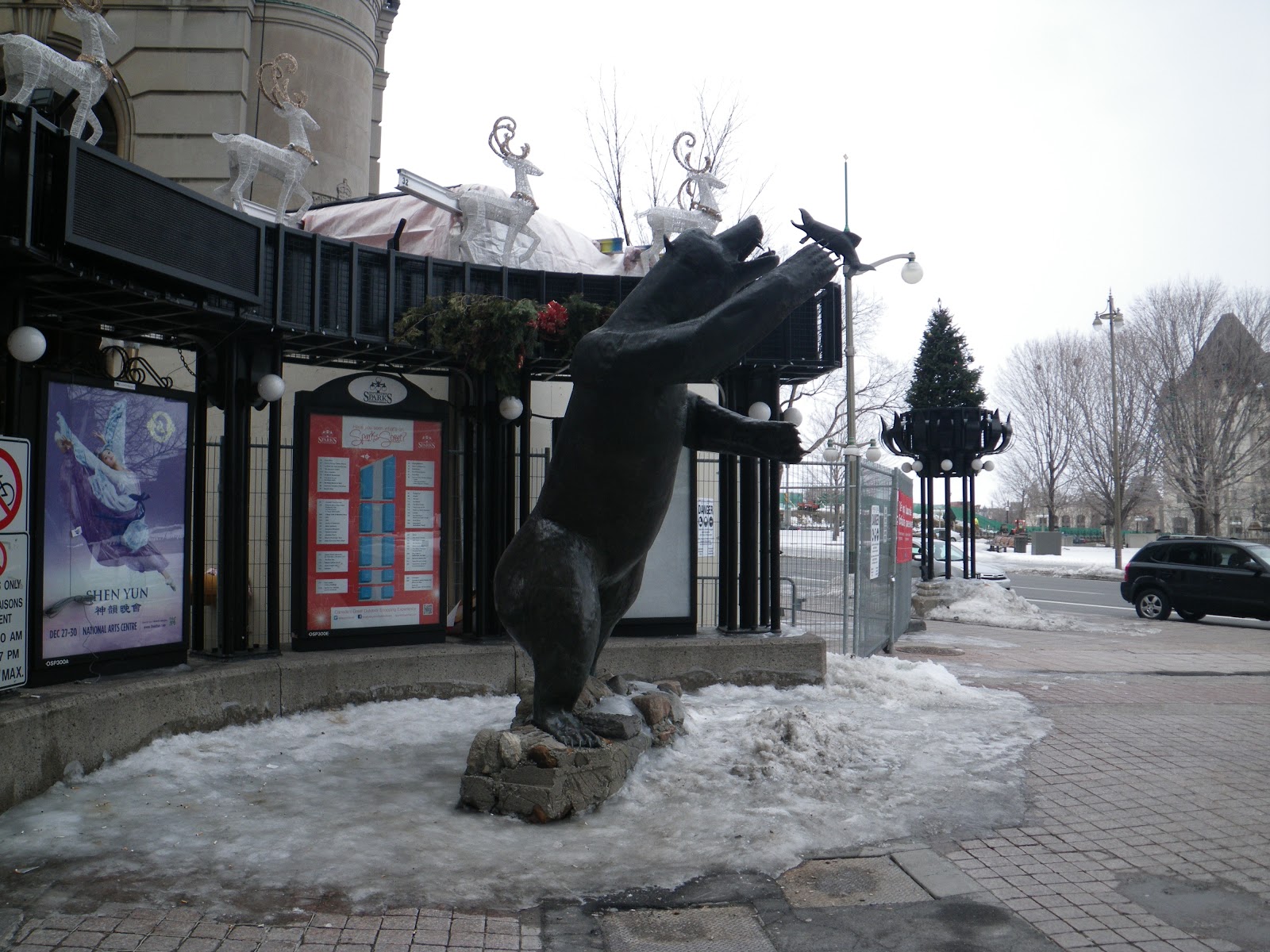
A familiar sight on Sparks Street is Bruce Garner's scuplture "Territorial Prerogative" at the intersection of Elgin and Sparks. I often see tourists taking their photos with the large bronze grizzly bear as I head to the post office.
Recently, it has come to light that the sculpture could be moving to make way for a new monument to commemorate the Stanley cup. This has triggered some additional attention to the sculpture, and the late Garner's work in general. [Edit May 2013: there is now a follow-up tour of additional Garner works]
Well, get out your red-and-blue 3D glasses*, because I've got three dazzling photos of the statue for your viewing pleasure. Looking west down Sparks Street:
[Tune in on Thursdays at noon for a new 3D image. View the 3D label for other posts with 3D images]
Looking north-ish (up Elgin toward Wellington, with the post office in the background):
And with the south-side buildings on Sparks in the background:
The sculpture was installed as one of a series of pieces highlighting fountains on either end of each block of Sparks Street. The fountain at this sculpture was de-activated years ago.
Also long since removed are are a pair of accompanying pieces, depicting a bear cub chasing a fish (as seen in the photo on this website.
(* If you don't have 3D glasses, you can pick them up for a couple dollars at the Comic Book Shoppe on Bank near Lisgar. Or flag me down; I usually keep a spare pair on me to give away.)
[Tune in on Thursdays at noon for a new 3D image. View the 3D label for other posts with 3D images. 3D FAQ]
A familiar sight on Sparks Street is Bruce Garner's scuplture "Territorial Prerogative" at the intersection of Elgin and Sparks. I often see tourists taking their photos with the large bronze grizzly bear as I head to the post office.
Recently, it has come to light that the sculpture could be moving to make way for a new monument to commemorate the Stanley cup. This has triggered some additional attention to the sculpture, and the late Garner's work in general. [Edit May 2013: there is now a follow-up tour of additional Garner works]
Well, get out your red-and-blue 3D glasses*, because I've got three dazzling photos of the statue for your viewing pleasure. Looking west down Sparks Street:
[Tune in on Thursdays at noon for a new 3D image. View the 3D label for other posts with 3D images]
Looking north-ish (up Elgin toward Wellington, with the post office in the background):
And with the south-side buildings on Sparks in the background:
The sculpture was installed as one of a series of pieces highlighting fountains on either end of each block of Sparks Street. The fountain at this sculpture was de-activated years ago.
Also long since removed are are a pair of accompanying pieces, depicting a bear cub chasing a fish (as seen in the photo on this website.
(* If you don't have 3D glasses, you can pick them up for a couple dollars at the Comic Book Shoppe on Bank near Lisgar. Or flag me down; I usually keep a spare pair on me to give away.)
[Tune in on Thursdays at noon for a new 3D image. View the 3D label for other posts with 3D images. 3D FAQ]
Monday, March 18, 2013
One last (hopefully) blast of winter
View other posts on these topics:
Bridgehead,
City Hall,
Florence,
Footbridge,
Gladstone,
Glebe,
MacLaren,
Parliamentary Precinct,
Pathways,
Queen Elizabeth Driveway,
Statues,
Trees,
Winter
The weather forecast suggests that we'll be getting another 20-centimetre blast of snow in the next couple of days. This might be my last chance this year to get some of my winter-related photos out before trying to forget that season and focus on spring and summer. So here goes.
Here's an inuksuk I built outside Bridgehead on Elgin after a snowstorm in December. It was one of those ones with really sticky snow. A couple of days after falling, that sticky snow had hardened into snow you could cut chunks from.
That was actually from the storm pictured below on Gladstone, where the snow 'flakes' were the size of frosted mini wheats. I hope this week's storm doesn't bring us this heavy stuff:
Here's an inuksuk I built outside Bridgehead on Elgin after a snowstorm in December. It was one of those ones with really sticky snow. A couple of days after falling, that sticky snow had hardened into snow you could cut chunks from.
That was actually from the storm pictured below on Gladstone, where the snow 'flakes' were the size of frosted mini wheats. I hope this week's storm doesn't bring us this heavy stuff:
Thursday, November 8, 2012
3D Thursdays: Autumn in Minto Park
It's the time of year when the weather gets colder and the leaves change colours. It's also Thursday, which means today's post is in 3D. Get your red-blue glasses out for this great shot of Elgin Street's Minto Park:
The focal point of the image is the statue of Argentinian General José de San Martin.
[Tune in on Thursdays at noon for a new 3D image. View the 3D label for other posts with 3D images]
[Look for more one-photo posts under the label Singles]
The focal point of the image is the statue of Argentinian General José de San Martin.
[Tune in on Thursdays at noon for a new 3D image. View the 3D label for other posts with 3D images]
[Look for more one-photo posts under the label Singles]
Wednesday, February 8, 2012
Cozy Oscar
It's cold outside, but the statue of Oscar Peterson, unveiled by Her Majesty Queen Elizabeth II on June 30, 2010, has a warm knit cozy around the prop.
Jazz music plays from speakers above the statue at the corner of Elgin and Albert, and it's popular for people to have pictures taken of themselves sitting next to Oscar on the bench. A great piece of interactive public art, right outside the National Arts Centre!
[Look for more one-photo posts under the label Singles]
[Look for more one-photo posts under the label Singles]
Monday, January 30, 2012
Thunder and snow
Just over a decade ago, the National Aboriginal Veterans Monument was unveiled at Confederation Park, across from the Lord Elgin Hotel on Elgin Street. After a recent storm, snow covered the wings of the golden eagle, (representing the mythical Thunderbird).
I remember watching the monument being installed. For a number of months before the opening, the big square rock on which the statue is mounted sat on its own. Finally, a statue appeared and it made a lot more sense.
Snow also means winter, which in Ottawa means Winterlude. Confederation Park is one of the primary sites for Winterlude, and the Lord Elgin already has its banner up promoting the event. There's also a trailer for a vendor to set up a waffle tent during Winterlude. The timing couldn't be better, as local blog Apartment613 has been fuelling interest in local waffles.
[Look for more one-photo posts under the label Singles]
Snow also means winter, which in Ottawa means Winterlude. Confederation Park is one of the primary sites for Winterlude, and the Lord Elgin already has its banner up promoting the event. There's also a trailer for a vendor to set up a waffle tent during Winterlude. The timing couldn't be better, as local blog Apartment613 has been fuelling interest in local waffles.
[Look for more one-photo posts under the label Singles]
Wednesday, December 21, 2011
The miniature street sweeper
View other posts on these topics:
Arts,
Confederation Park,
Elgin,
Laurier,
Models,
NCC,
Parks,
Renovation,
Statues
Back in October when the Occupy Ottawa protest was still well-established in Confederation Park, I went by a couple of times to see what there was to see. Someone with a generator, bucket, and various tools was at the NCC's miniature bronze map of downtown Ottawa-Gatineau. The more tourist-oriented streets appear to be brass, and this person was cleaning them with a Dremel and various abrasive sponges.
I didn't realize she wasn't with the protesters, as a gasoline generator and water jugs was the kind of thing the protesters would have with them. But it turns out she works for the firm of the original artist, which was hired by the NCC to do some cleaning and updating some features on the map (like adding the new Convention Centre and removing the Capital Infocentre).
I chatted with her briefly, but unfortunately it's been too long for me to remember any noteworthy details.
Click on the photos to view full-size. I think it's a neat throwback to the scale models used by Jacques Gréber to illustrate his plans for the capital (Such as #151 and others listed here)
Friday, November 11, 2011
Monument to Canadian Fallen in Korean War
View other posts on these topics:
Bridges,
Holidays,
Mackenzie-King Bridge,
Statues
It's quite easy to walk all around Centretown and not pass by this monument on the Mackenzie-King Bridge to Canada's fallen in the Korea between 1950 and 1957. On the front of the statue is written "We will never forget you brave sons of Canada," and inscribed around it are the names of the 516 Canadians who died in that conflict.
The monument was opened in September 2003 by then-Prime Minister Jean Chrétien and Korean ambassador Chang Hi-Ko. It was designed by Vincent R. Courtenay, a Canadian Korean War veteran, and sculpted by Yoo Young Mun.
In front of the monument is a plaque describing the significance of the imagery (click to view full size). The children are carrying maple leaves (symbolizing Canada) and roses of Sharon, the national flower of Korea.
The edges of the plaque and the monument are connected by two rows of pavers that meet at a point. According to the plaque, the resulting angle points in the direction of Busan, South Korea, where an identical monument sits at the site of a United Nations memorial cemetary that contains the graves of 378 Canadians.
The names wrap around to the back of the monument, where additional relief repeats the English moto banded around the front, and an inscription on the stone indicates that the Korean Granite plinth was provided by the Government of the Republic of Korea.
In front of the monument is a plaque describing the significance of the imagery (click to view full size). The children are carrying maple leaves (symbolizing Canada) and roses of Sharon, the national flower of Korea.
Monday, October 17, 2011
Happy (Centre)Town
You've perhaps walked by the little fenced- and hedged-off lot at the corner of Florence and Lyon and never given it a second thought. It's next to the little Ottawa Hydro transformer station on Lyon just North of Bay.
Through the trees, though, is a great little piece of fun:
I'm out of town this week, so blogging may be spotty this week too.
[Look for more one-photo posts under the label Singles]
Through the trees, though, is a great little piece of fun:
[Look for more one-photo posts under the label Singles]
Wednesday, June 8, 2011
One Hundred Foot Line
[Somehow Blogger set this to post at 11:58pm (midnight) instead of 12:00pm (noon). Sorry about the delay.]
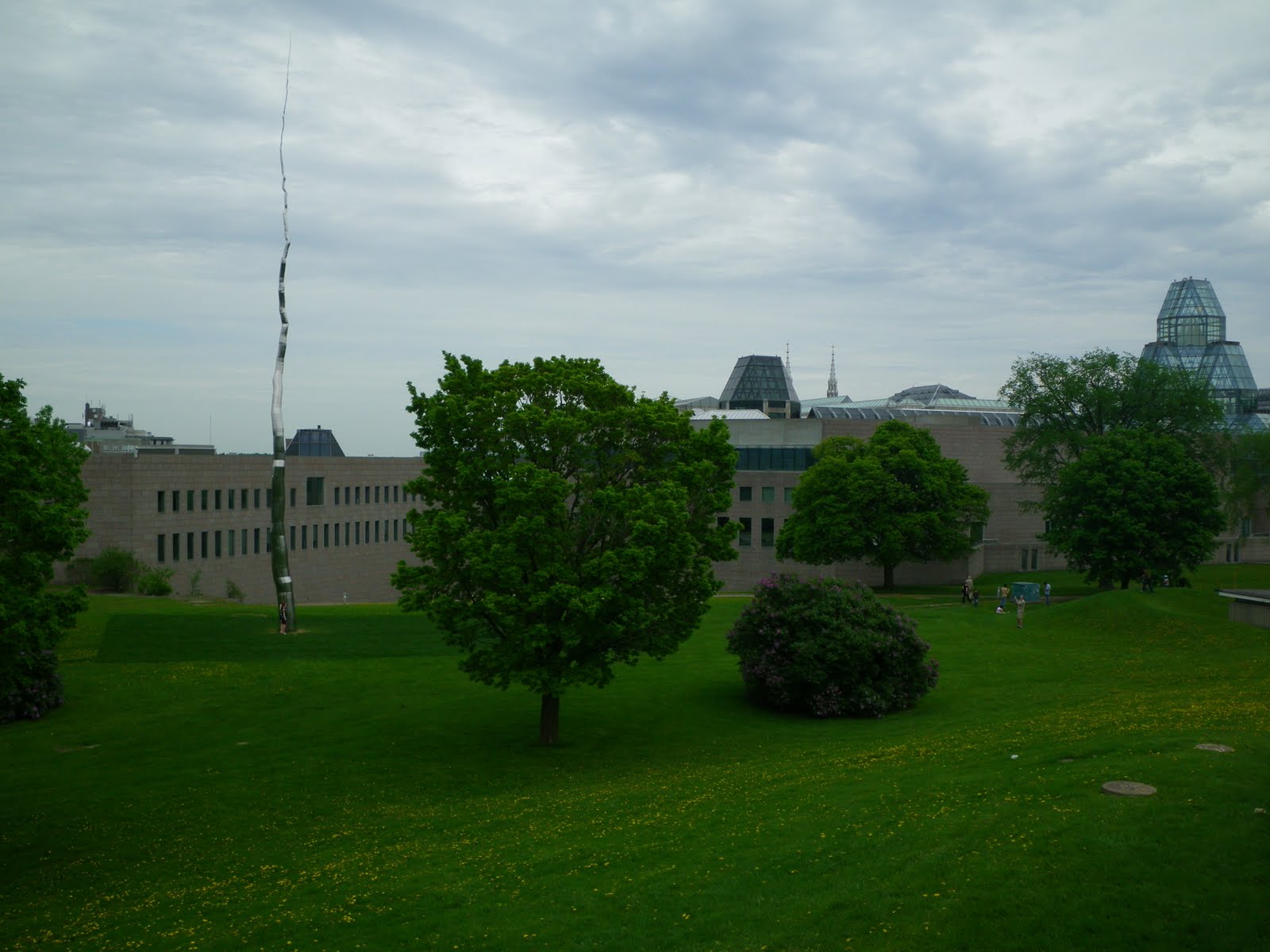
As promised in the post about Nepean Point, here is a photo of the controversial sculpture One Hundred Foot Line by New York artist Roxy Paine. Part of the controversy, aside from the regular complaining about the National Gallery of Canada spending money on art by non-Canadian artists, was a series of complaints by a certain Ottawa Citizen columnist that At 10 storeys, it screams and distracts from the star structures of that area, the Parliament Buildings. It is completely out of context.
However, As I mentioned in a photo in the previous post, about the only place you can see both the Paine sculpture and the Parliament buildings is from Nepean Point, and even then they're in opposite directions.
As for "out of context", nearly any photo of the Line from Nepean Point shows a number of other vertical interventions far less attractive (though admittedly less expensive) than the sculpture:
Just to give you an example of how obtrusive they are, I had to put my camera on a timer and stick it out as far as I could reach on my tripod just to get the Line and the National Art Gallery atrium in the same shot without a post or lamp in the way. You can just make out the tip of the restroom facility on the right at the base of the hill in both photos.
I think it looks pretty good, actually. It pretty much dominates the skyline but there's nothing else of visual interest in this direction from which it might distract. At any other angle (i.e. at ground level), the only thing you can see beyond it is trees and sky. And on a day like this one, it quite effectively disappears into the sky as though it went all the way up to the clouds.
As promised in the post about Nepean Point, here is a photo of the controversial sculpture One Hundred Foot Line by New York artist Roxy Paine. Part of the controversy, aside from the regular complaining about the National Gallery of Canada spending money on art by non-Canadian artists, was a series of complaints by a certain Ottawa Citizen columnist that At 10 storeys, it screams and distracts from the star structures of that area, the Parliament Buildings. It is completely out of context.
As for "out of context", nearly any photo of the Line from Nepean Point shows a number of other vertical interventions far less attractive (though admittedly less expensive) than the sculpture:
I think it looks pretty good, actually. It pretty much dominates the skyline but there's nothing else of visual interest in this direction from which it might distract. At any other angle (i.e. at ground level), the only thing you can see beyond it is trees and sky. And on a day like this one, it quite effectively disappears into the sky as though it went all the way up to the clouds.
Monday, June 6, 2011
Astrolabe Theatre on Nepean Point
Despite growing up in Ottawa, I realized I'd never been to Nepean Point when the Citizen reported that the NCC would be taking down the theatre there. In fact, I didn't even know there was an amphitheatre at Nepean Point. So on a half-decent Saturday last month I went up there to check it out (if you follow me on Twitter or just the photos), you'd have seen some of the photos I took with my phone at the time.
Nepean Point is characterized by the statue of Samuel de Champlain, who is portrayed holding up an astrolabe (when instead it should be suspended). The statue of the Anishinabe scout used to be on a plinth at the base of Champlain's statue, until it was removed for good taste. You can see the plinth in the photo below right under Place du Portage in the background.
Friday, February 18, 2011
The ice people drinketh
Many Centretown businesses take part in the annual Winterlude celebrations, which take place on the first three weekends of February. Many participating hotels will have an official "Winterlude" ice sculpture outside their front entrance. Other businesses, like the Sir John A pub on Elgin Street near MacLaren, host ice scupltures, like this one of two skaters enjoying a drink:
Of course, the biggest Winterlude attraction is the 7.8-kilometre long Rideau Canal Skateway, the world's largest skating rink. Unfortunately, both the canal and this sculpture have suffered from this week's midwinter thaw. In their stead, why not check out my many previously-posted photos of the canal, under the label "Canal".
[Look for more one-photo posts under the label Singles]
[Look for more one-photo posts under the label Singles]
Monday, October 11, 2010
Ottawa Chinatown Gateway Arch--with Grace
This is Grace Xin (pron: "Shin"), whose tenure as Executive Director of the Somerset Street Chinatown Business Improvement Area (BIA) ends on October 15, 2010. Here, Grace is pictured Thursday afternoon, after pulling off a remarkable ceremony to officially open the Ottawa Chinatown Gateway.
While the project has been in development for decades, the first public expression was this 3D mural built on the wall of a neighbouring building in September 2007. It was made by Cairn Cunnane as a partnership between the Somerset Street Chinatown BIA and the Ottawa Police Service, hence the police officer in the final mural:
The Gateway was built as a partnership between the BIA, various donors, all three levels of government, as well as the Chinese embassy and the City of Beijing. It is built across Somerset Street West at Cambridge Street North, which is seen here in early April 2010 [edit: Justin Wonnacott's Somerset Online has a picture of it in 2006]:
The official groundbreaking ceremony was held on April 22, 2010, with a who's-who of Ottawa and of Chinatown in attendance. A traditional ceremony was held with firecrackers, incense and a roast pig, followed by a Western ceremony--a symbolic shovelling of a pile of dirt that had been specially carted onto Cambridge Street for the occasion.
Also in the audience at the ceremony were the labourers brought in from China to build the gateway:
The gateway was built in three distinct phases, the first two of which required Somerset Street to be closed to traffic for two months starting May 31, 2010. In the first phase a local contractor buried the adjacent power lines, then constructed the massive footings (which go down 28feet into the bedrock) and the columns and structural part of the arch. Here we can see the cylindrical forms for the steel-reinforced concrete columns that will support the 100-ton arch:
The second phase involves the Chinese artisans building and installing the roof pieces and decorative panels. They did this, using special wooden moulds built by artisans in China, in a staging area in the lot behind the Yangtze restaurant on Cambridge Street North (where some abandoned houses were demolished due to frequent fires).
Because of Ottawa's sister-city status with Beijing, Ottawa's gateway is a Royal Arch, with nine roofs--the greatest number in Chinese numerology. (Chinese numerology is also why the opening ceremony was at 3:58 instead of the unlucky 4 o'clock)
Built into the structure of the arch are sybols of good luck: five Chinese coins--one from the Tyng Dynasty, over 1000 years old, and one from the Ching Dynasty, about 200 years old--made of gold, silver, copper, iron & tin, and five coloured threads (red, yellow, blue, white & black).
By mid-June, four of the roofs had been installed:
In late June, three more roofs were added to the top:
These last two roofs were built just a little bit too wide, and didn't fit as they were supposed to, as Eric explained at the time. They would be modified and installed later, until which time they sat out on the road.
Eventually, all nine roofs were placed, and the glazed roof tiles were installed on top of them. Work was also underway to reconstruct the sidewalks in the vicinity.
Decorative panels were installed in the gaps under the arches in July.
And on July 31, traffic was restored under the gateway. New scaffolding was erected for the third phase: painting. This involved a different team of Chinese artisans that came in after the first team left.
The lowest part of the gateway is 5m (16') high, and the top is 11m (33') above street level. The two pillars are about 12m (36') apart, and the entire structure weighs about 130 tons (including the 30-ton footings). These artisans preparing the roof areas for painting are dwarfed by the massive structure:
Throughout August and September, the artisans continued to paint the arch in bright colours. I posted a photo at the time, with links to other coverage of the painting.
By the end of August, much of the painting was finished and the artisans turned to trimming the arch with half a kilogram (over 1 lb) of gold leaf. The dragon panels had not yet been gilded in this picture, and still showed the yellow paint:
By mid-September, the work on the gateway was complete, and the upper scaffolding was removed. The columns only had a coat of primer, and the lower scaffolding had yet to be reomved.
Fast-forward to October 7th, where sunny weather welcomed a large crowd in the official opening ceremony. Chinese Ambassador LAN Lijun, Federal Government House leader John Baird, Ottawa-Centre MPP Yasir Naqvi, Ottawa Mayor Larry O'Brien, and LIANG Wei, Senior Advisor of Beijing Municipal Government, all spoke at the event.
The two lions guarding the gateway were unveiled at the end of the ceremony by Somerset Ward Councillor Diane Holmes, Somerset Street Chinatown BIA Chair Peter So (owner of So Good restaurant), and other BIA representatives and contributors: Larry Lee, Peter Yeung,Frank Ling, Bill Joe, Ron Tomlinson, and Marion Hum. By this point, the invited audience members had all gotten up from their seats to join the media in taking photos, and those of us in the crowd took our own photos from beyond the fence. Robin Kelsey does a good job of explaining the symbolism of the lions on his blog.
Here is the male lion. Mayor Larry O'Brien and LIANG Wei then 'painted' the eyes of the lions to let them see, and a ribbon with the logos of Canada, Ontario, Ottawa, and Beijing was officially cut.
To top off the ceremonies, Chinese dragons danced at the base of the arch while everyone watched and celebrated:

The gateway is remarkably beautiful, and the artisans did an excellent job. Note the reflection in the red paint on the side of the roof section:
This great ceremony was all in a day's work for Grace Xin. Thank you and congratulations, Grace!
For more photos of this arch and others around the world, visit www.ottawachinatownroyalarch.blogspot.com/, maintained by Eric Darwin.
Built into the structure of the arch are sybols of good luck: five Chinese coins--one from the Tyng Dynasty, over 1000 years old, and one from the Ching Dynasty, about 200 years old--made of gold, silver, copper, iron & tin, and five coloured threads (red, yellow, blue, white & black).
By mid-June, four of the roofs had been installed:
The gateway is remarkably beautiful, and the artisans did an excellent job. Note the reflection in the red paint on the side of the roof section:
Subscribe to:
Comments (Atom)