The media are doing it again. They're falling for (and contributing to) neoconservative flamebait by sensationalizing a non-story that accuses City Council of wasting money it didn't spend. I hate it when they do that, because it inevitably results in me spending five hours into the night carefully deconstructing and documenting their errors.
It has to do with the paramedic post on the former Beaver Barracks site at 424 Metcalfe (intersection of Catherine), and accusations of "poor planning" relating to it.
The culprits:
- The Ottawa Sun (
article in question) (link may not work after a while)
- CBC Online (
article in question)
- The Canadian Taxpayer Federation (representatives of which are quoted in above articles)
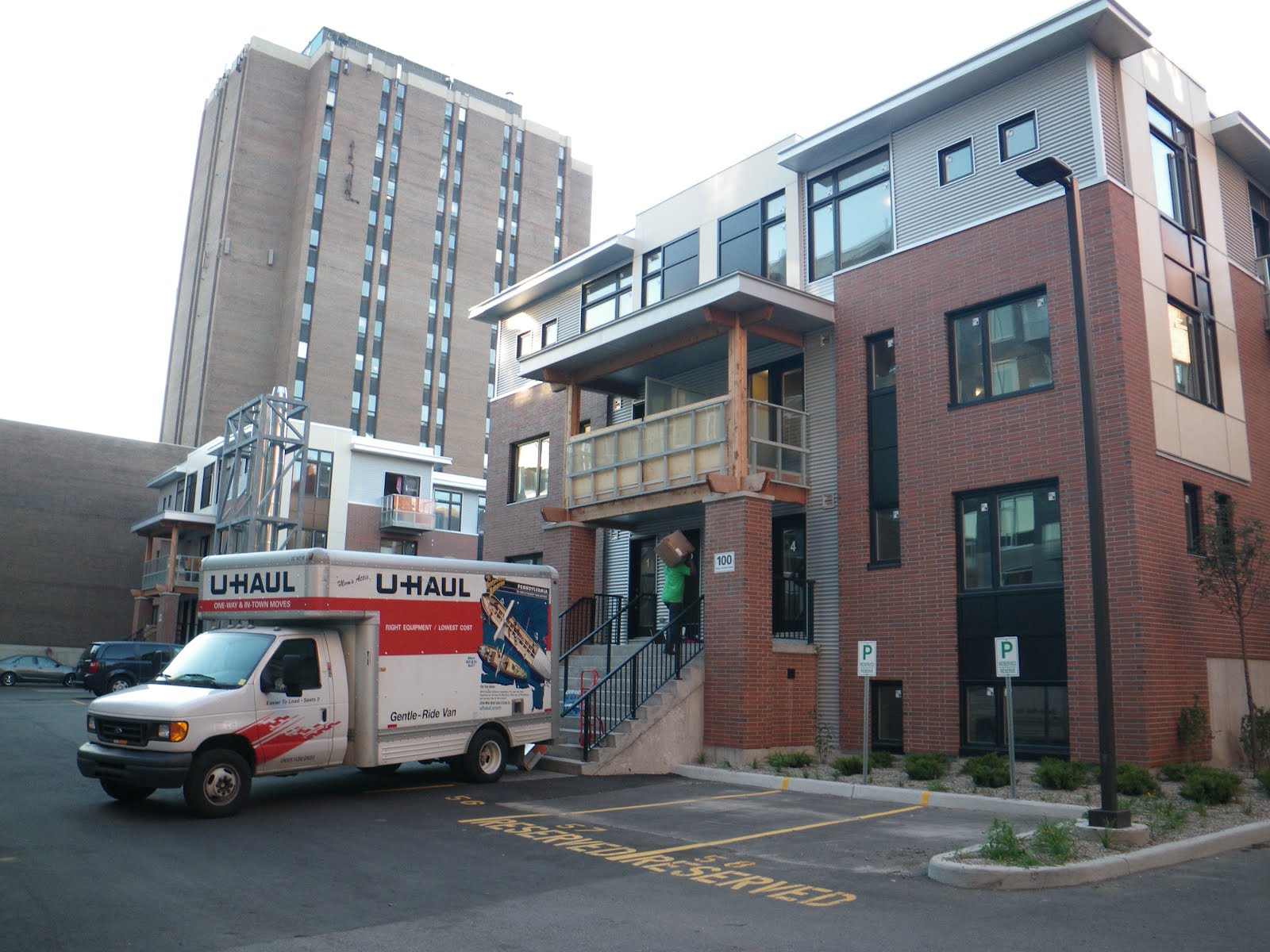
Here's a photo of the site in question:

 So what's the issue? Well, a Paramedic Post built by the City of Ottawa for $600,000 in 2004 is being demolished and rebuilt on a different part of the same site. From this brief description, which is the same simplistic angle taken by the Sun (see yesterday's cover, inset) and CBC Online (the headline was "New $600K Ottawa ambulance station to be torn down, rebuilt"), you'd think that the City had just spent $600,000 with nothing to gain. And the taxpayer zealots are firing all guns.
Adam Taylor, research director for the Canadian Taxpayers Federation, says this is "poor planning at best and it's incompetence at worst." (CBC article)
Kevin Gaudet, the Ontario director for the CTF, cites his flawed dogma in the Sun article: 'To have a new building that has to be torn down to accommodate a newer building, at the initial expense of the taxpayer, is an absurd waste of money, Gaudet says.' (my emphasis; note, this is a quote from the article paraphrasing Gaudet, not a direct quote)
Some commenters on the CBC article take the bait and blame the city for gross incompetence, including Gary68, who "seriously demand[s]" that Councillor Diane Holmes resign.
Anyway, they're all completely wrong, many times over.
Now, I'm not an apologist for City Council (nor am I necessarily an opponent), but in the wake this bombardment of illogic I must come to the defense of Council and Councillor Holmes. You see, I did something most people didn't think to do: I actually looked at the evidence.
Let's start by explaining the current situation. The City of Ottawa owns some property (called the "Beaver Barracks site", named after the temporary buildings built during WWII for the Department of Defense) which is designated to be used for affordable housing. The site has also hosted community gardens since 1997. In 2004, the City of Ottawa constructed a building on the site for paramedics to rest while waiting for calls. This particular location is useful because the proximity to the Queensway and to Centretown arteries allows ambulances to serve Centretown well.
A new affordable housing development on the site will require this Paramedic Post to be relocated within the site (the new one will be completed before the old one is demolished).
Despite the initial cost of the Paramedic Post, both the Sun and the CBC report that this relocation will cost only $100,000, and that the cost will be borne by the CCOC. But these details are buried within both stories; the Sun and the CBC both chose to inflate the issue by parading the $600,000 figure, allowing the taxpayer "defenders" to stick to their dogma.
Gaudet claims that no matter the cost to relocate, $600,000 was misspent because that was the initial cost spent by the City, and that claim is absurd. If I were evicted from my apartment and had to move to a comparable apartment with equal rent, I would be out the money it costs to transport my furniture to a new house--not the price of my furniture!
When Taylor was told that the cost to replace the building was only $100,000, he still insists it's money wasted by the government, since the CCOC project is funded by the government.
Now let's start to deconstruct this.
First, was it a poor financial decision?
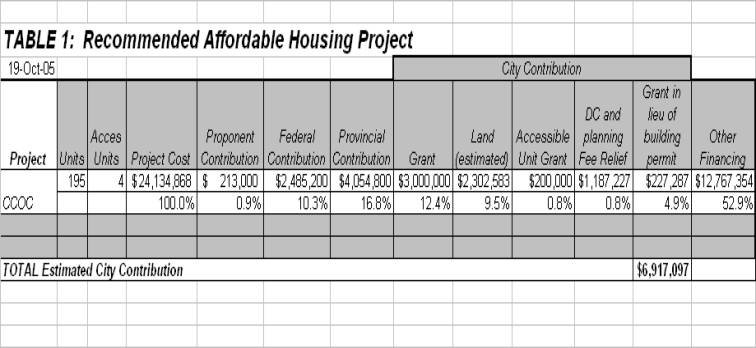
In mid 2007, the City issued an RFP (Request-for-Proposal) for social housing to be developed on the site. The Centretown Citizens Ottawa Corporation (CCOC), which is a non-profit organization specializing in providing affordable housing in central Ottawa, won the competition by a large margin at committee (Council approval here), with a $24.1 million proposal, 55% of which would be funded by governments (approx. $2.5M Federal, $4M Provincial, and $6.9M Municipal).
This means that of the $100,000 expense, only $55,000 is borne by governments at all levels.
When the Paramedic Post was approved, the City did not have any firm plans for the site (as I demonstrate in the last section below). In order to prevent conficts with a future development, the City would have had to wait until plans are drawn and executed, or build the paramedic post on another site.
To find another site would have required the city to purchase land from a private landholder, and land in Centretown would have certainly cost more than $55,000.
If they had waited, they would also have lost out. Inflation on the $600,000 investment between 2004 and 2008 would be $61,000, according to the Bank of Canada's Inflation Calculator (Yes, that uses the Consumer Price Index, which does not necessarily reflect construction costs, which I believe have risen faster than inflation).
Even if it didn't cost more, waiting would have been hazardous as well. Remember, it's not just about construction and spending, a Paramedic Post is about the safety of Citizens of Ottawa. The purpose of this Paramedic Post is to provide paramedics a place to park their ambulances so that they can swiftly respond to calls. Ambulance response times have been below targets in Ottawa for many years, and downtown was identified as needing more attention.
Now, take any of the figures, $100,000, $55,000, or $600,000 and divide by four years of operation (five, when you consider the CCOC-built Paramedic Post will not be ready until 2009), and it is much less than the cost of operating an ambulance with two paramedics (and that's only counting one shift!). Had we not built the building, how many more ambulance teams would we have had to sit on duty?
When the post was built in 2004 (or more specifically, when it was approved in 2003), there were no specific plans for the site. I dare anybody to look at interminably-undeveloped Albert Street and Transitway in the escarpment, or the lack of proper transit downtown, and try to claim that we should have waited for the City to implement plans before making this investment in safety.
It is not a waste to spend taxpayer money; only if it is spent poorly. Paradoxically, Council's poor record in planning suggest that it was actually a good planning decision for this project to go ahead as soon as was possible.
When did they make the decision to build it?
Logic and analysis aside, people are still calling for the heads of Diane Holmes and of Council. So let's take a look back in time and see where this all came from. The online minutes of Council and Committees are a good help. (as an aside, I think the Mayor's desire to spend $150,000 to go paperless is a much bigger waste of taxpayer money; the current online minutes seem to work well enough for this research...)
According to the Beaver Barracks development website, the RCAF Beaver Barracks were built on the site in the 1940s, with residences along Catherine, the Ottawa Auditorium along O'Connor, and a mess hall along Argyle. The site has a drawing from 1956 showing the site layout.
The site goes on to say that the auditorium was demolished to make way for the Metro Central Y in 1967, and the barracks themselves were taken down in 1991 leaving a field. It is now listed as a Brownfields site, according to this document from the province (translated in to html by Google). --Incidentally, the City is contributing $300,000 to clean up the toxic waste in the brownfields site, but I don't hear the Taxpayer's Federation whinging about that.--
At some point during this period, according to Councillor Cullen's recollection in a 2003 meeting, this site had been transferred to the City of Ottawa in a land swap between the Regional Municipality of Ottawa-Carleton (RMOC, precursor to the City of Ottawa), the Department of National Defense and the National Capital Commission.
Fast forward to September 2003. The City of Ottawa has identified the need to build 12 Paramedic Posts in high-density areas (reduced from an earlier estimate of 21 posts). Funds were already set aside to build them, they just needed to find places that were appropriately zoned. The Planning and Development Committee was urged by Staff to rezone this site to include such a Post in the permitted uses. Quoting from the Planning and Development Committee report's summary of the presentation by Anthony Di Monte, Director of the City's Emergency Medical Services department:
"In the Centretown area, 28% of the life-threatening calls emanate from this
high-density area, representing some 10,000 emergencies. It is an
essential public and health safety issue that needs to be
addressed. ... This area lacks the capacity to respond to an
extremely high level call volume. Having said that, funds were set aside
to build posts where deemed necessary and through the planning process this area
was identified. It is City land and ideal because of the call
volume." (my emphasis)
--Let me pause the history lesson here for a moment to point out that at the time of this meeting in 2003, Diane Holmes was not a City Councillor, and nor were half of the 24 people on Council today in 2008. So Gary68's implication that Holmes is responsible for this alleged boondoggle is grossly misplaced, and arguably defamatory.--
The idea for using the site for affordable housing dates as far back as 1999, when the RMOC voted against having the site "be the subject of further planning studies and that a portion of the site be considered for affordable housing in the future." (PDF reference, or translated to HTML by Google). It's unclear whether it was already set aside for affordable housing by that point and the motion was to consider developing it, but by the 2003 PDC meeting, it was clear that affordable housing was to be one of the main purposes for this site.
Interestingly, affordable housing was not the sticking point in the debate on the Paramedic Post. Instead, it was concern that the Paramedic Post would push out the community gardens maintained on a portion of the site by the Bytowne Urban Garden Society (BUGS) since 1997.
An avalanche of community support called on the committee to make development of a Paramedic Post and affordable housing contingent on the existence of the garden. This contingency, staff said this does not represent "good planning". But this is not a foreboding of the "bad planning" accusations referred to in 2008--staff were still supportive of the ambulance post.
Councillor Cullen was very persistent in expressing his concern that the ambulance post would reduce the potential for affordable housing spaces, but it appears staff never answered his question of how many spaces could be gained by not locating the ambulance post there. This, of course, still begs the question of how much it would cost to locate it elsewere and whether that gain would have been worth it. In retrospect, we now know that the Post is incorporated as the ground level of a mixed-used building, so in an alternate reality, the CCOC might just as well have made the space into a convenience store and no additional housing units would have been gained.
Russell Mawby of the Housing Branch replied at the time that "EMS does not
significantly impact the housing development potential on the site" and "Housing is proceeding on the premise there will be an EMS facility on the site." Grant Lindsay, the City Manager answerable for the agenda item, said "the site could possibly accommodate all three uses quite comfortably."
The rezoning carried at Council, with Dwight Eastman (West Carleton) dissenting on the recommendation to include the community gardens.
As for the actual construction of the ambulance site, I can't find any reference for when it was built, or--more importantly--when it was approved. The closest is a few thousand dollars in approvals for Architectural ($51,000) and Environmental Consulting Services ($15,000)--ironically, one is listed for this "Ambulance Post" and the other for an unspecified "Proposed Paramedic Post" (the latter of which may not be the one in question). This lack of documentation implies the approval to build the paramedic post was buried in an annual budget, probably under project funding for EMS. So the decision was not exactly a prominent one, and the nuance of the now-acknowledged financial implications were far from apparent--even the CTF didn't catch it at the time!
Building the affordable housing
Finally, in August of 2004, the City issued an RFP for 220 units of affordable housing, 140 of which to be situated at the Beaver Barracks site. $7.3 million in funding was allocated to support this site.
This is probably after the paramedic post was built, likely after it was designed, and almost certainly after it was approved. Since my main point is to disprove the claim that it was a boondoggle, this timing confirms there were no plans for the housing when the paramedic post was built.
To further support this, in June 2006 on an unrelated issue at the Beaver Barracks site, it was reported that "A design plan is expected in 2006, and site development could begin as early as the summer of 2007."
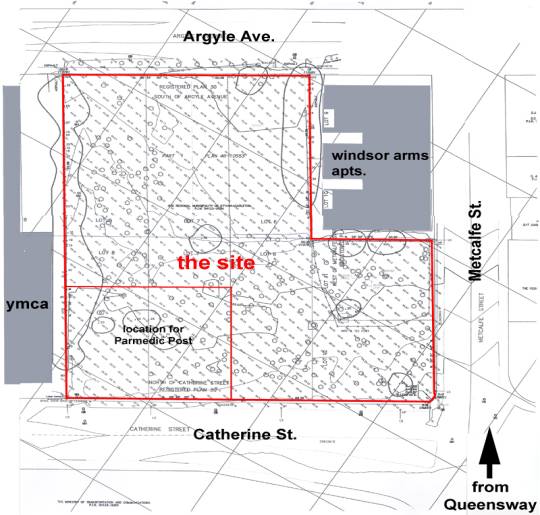
 In July 2007, the Community and Protective Services Committee approved a proposal by the CCOC to build 100 affordable housing units on the site (approved by Council here). Even then, there was no detailed site plan, only an outline of the site, with a square in the corner marked "location for Paramedic Post" (at right).
This was the first opportunity for a developer or architect to look at the existing site layout and see where the Paramedic Post would fit in with the proposed number of units.
It wasn't until May of 2008 when the detailed design was presented to the Local Architectural Conservation Advisory Committee (PDF of proposed design). Detailed 3-D renderings are available online, as is an interactive plot of current, Phase I, and Phase II site plans. Remarkably, the CCOC's design proposal appears to include over 250 units, 175 of which qualify as affordable housing.
In Phase I, they will build a new building with 105 apartments and a new paramedic post on the ground floor. In Phase II, they will demolish the old paramedic post and build another building along Catherine Street.
Other virtues of the project put the nail in the coffin on the "wasting taxpayer dollars" argument. According to this proposal (PDF) for the project, Phase II expects a similar investment from the City of Ottawa as Phase I, except they will not need the City's $30,000 per door capital grant. They are also budgeting $56,000 for public art, and are making a number of inroads in sustainable development, including construction to LEED Silver and/or Gold standards, partnership with Vrtucar, and of course its neighbours the YMCA and BUGS.
After a careful and thorough analysis, I think that Council made a prudent decision at the time, and in retrospect, the investment in the safety of citizens was not excessive compared to any alternatives. When all is said and done in 2009, $700,000 will have been spent, $600,000 of it directly by the City, and we will have had the services a Paramedic Post for five years, situated in brand new facilities.
But then, it's easier to just scream "WASTE!", isn't it? Shame on the Sun and CBC for kowtowing to sensationalists and highlighting their misrepresentations in headlines and giant print.